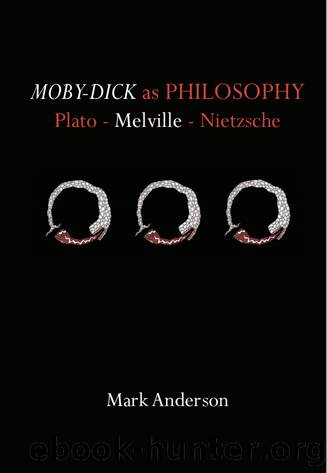
Moby-dick As Philosophy : Plato - Melville - Nietzsche (9780996772518) by Anderson Mark
Author:Anderson, Mark [Anderson, Mark]
Language: eng
Format: epub
ISBN: 9780996772518
Publisher: Lightning Source Inc
Published: 0101-01-01T00:00:00+00:00
Chapter 76:
The Battering-Ram
This chapter of Moby-Dick, in which Ishmael continues his commentary on the Sperm Whaleâs massive head, concludes with an allusion to the inarticulable horror that âbefell the weakling youth lifting the dread goddessâs veil at Sais.â Plutarch preserves the ancient account of a cloaked statue of Isis that once stood in the Egyptian city of Sais, but Melville relies more immediately on Schillerâs poem âThe Veiled Statue at Sais.â According to the narrative therein related, hidden behind the statueâs veil is nothing less than Truth itself. When a young Egyptian seeker of knowledge learns of this from a priest, he immediately longs to expose the truth so as to learn it, to possess it; but the priest warns him off by appealing to the deityâs own prohibition against lifting her veil. Nevertheless, the brash young man will not be dissuaded. He returns to the temple at midnight, and sneaking over the walls he approaches the goddess. Standing then before the Truth incarnate, he removes the veil and gazes excitedly on it. What does he see? No one knows, for when he was found the following morning passed out before the statue, an expression of dread distorting his pallid mask of a face, he refused to speak it. Nor did he ever after disclose the secret. His remaining days he passed in sorrow, and he died the premature death of a wrecked man.
Nietzsche alludes to this story in the first section of the second book of The Gay Science. Headed âTo the realists,â the passage expresses Nietzscheâs rejection of realism, realism in this instance being the idea that âthe world really is the way it appears to you.â Nietzsche mocks the realistsâ naive belief that reality stands unveiled before them, their refusal to acknowledge the âhuman contributionâ to our experience of reality. This human contribution, according to Nietzsche, includes the most fundamental elements of our experience of reality: the âerroneous articles of faithâ that âthere are enduring things; that there are equal things; that there are things, substances, bodies; that a thing is what it appears to be,â also that there are âlines, planes, bodies, atoms, divisible time spans, divisible spaces,â and âcause and effect.â Now just consider for a moment your conception of the world, then subtract from it all things and even the very notion of thinghood. What is left of a world from which enduring things have been withdrawn, not to mention the atoms of which thingsâand even the lines and planes of which three-dimensionality itselfâare composed? A world without any âarbitrary division and dismembermentâ into individual things causally related one to another would be an undifferentiated blur, a field of indistinguishable distortion, a world, in short, without Being, and therefore a radically Heraclitean âcontinuum and ⦠flux.â If the human contribution is indeed so extensive, then, Nietzsche concludes, âThere is no ârealityââ independent of it, no more for the realist than for the anti-realist. And notice the scare-quotes in which he encloses the word reality: the letters spell out the mere ghost of an idea, an empty concept.
Download
This site does not store any files on its server. We only index and link to content provided by other sites. Please contact the content providers to delete copyright contents if any and email us, we'll remove relevant links or contents immediately.
| Anthropology | Archaeology |
| Philosophy | Politics & Government |
| Social Sciences | Sociology |
| Women's Studies |
Born to Run: by Christopher McDougall(7131)
The Leavers by Lisa Ko(6950)
iGen by Jean M. Twenge(5419)
Sapiens by Yuval Noah Harari(5374)
Spare by Prince Harry The Duke of Sussex(5202)
The Kite Runner by Khaled Hosseini(5185)
Machine Learning at Scale with H2O by Gregory Keys | David Whiting(4317)
Bullshit Jobs by David Graeber(4195)
Never by Ken Follett(3961)
Goodbye Paradise(3812)
Livewired by David Eagleman(3776)
Fairy Tale by Stephen King(3401)
A Dictionary of Sociology by Unknown(3086)
Harry Potter 4 - Harry Potter and The Goblet of Fire by J.K.Rowling(3076)
The Social Psychology of Inequality by Unknown(3038)
Will by Will Smith(2929)
The Club by A.L. Brooks(2927)
0041152001443424520 .pdf by Unknown(2849)
People of the Earth: An Introduction to World Prehistory by Dr. Brian Fagan & Nadia Durrani(2739)
